

When I first began providing medical care in Asia in 1995, many countries in the region were still struggling with poverty. Japan, by contrast, had already moved beyond its economic bubble.
In Myanmar, for example, approximately half of Japan’s population lived on a national budget that was only a fraction of Japan’s. Just 1% of that budget was allocated to health and welfare, compared with the substantial public resources devoted to these areas in Japan. I believe that people living in poverty in these countries deserve better. After all, the only difference between them and us is where we happen to have been born.
When I first set out to bring medical care to people who had no access to it, my goal was simple: to make medical care accessible to those who need it. This remains the foundation of Japan Heart’s work today.
Japan Heart 1.0: Bringing Medical Care to People Living in Poverty
Yet countless people continued to fall through the cracks.
Approximately 1% of children are born with congenital heart disease. Others suffer from liver and kidney diseases. Each year, an estimated 3,000 children in Myanmar and nearly 1,000 in Cambodia develop cancer.
At the time, there was little we could do for these children but watch them pass away. Wealthier families could travel abroad to seek treatment, even in poorer countries. But many families living in poverty had no such option, and their children were left to face tragically short lives without the care they needed.
About ten years after I founded Japan Heart, more medical professionals began joining our mission. Together, we finally began treating children with serious and complex diseases- children we had once been unable to help, and whose lives and families had stayed with us.
Our work expanded to include treatment by specialized cardiac teams, the training of local medical professionals, and advanced treatment for children with complex surgical conditions through collaborations with university medical teams and specialist hospitals. We also began transferring advanced medical skills, including liver transplantation, to local healthcare professionals.
Building on the foundation of Japan Heart 1.0, these efforts represent our ongoing commitment to creating a world in which everyone, regardless of nationality, has the fundamental right to live a healthy life.
Japan Heart 2.0: Bringing Advanced Medical Care to People Living in Povertyy
Working in healthcare overseas opened my eyes to realities I had never fully recognized in Japan.
I had naively believed that people living in poverty would gladly receive medical care if it was free. I also believed that providing treatment alone was enough.
However, I came to realize that the burden of accessing healthcare extends far beyond the cost of treatment. I had given little thought to the circumstances families face while a child is receiving care: their financial situation, the emotional stress experienced by siblings, the impact on children’s education, and the emotional toll on families who lose a child.
These challenges exist in developing countries and in Japan alike. In fact, perhaps these are issues that deserve even greater attention in Japan today.
Should we not redefine healthcare to encompass all these aspects of a patient’s and family’s well-being?
I began to reflect deeply on this question. Over time, I became convinced that healthcare cannot be delivered by medical professionals alone. We must involve government agencies, people from other fields, and volunteers from all walks of life.
I believe we must move beyond the traditional boundaries of healthcare and work together across different fields to create a new system of mutual support suited to the needs of our time.
Japan Heart 3.0: Creating a New Concept of Healthcare
There is still a long road ahead. But the only way forward is to keep moving forward.
Dr. Hidehito Yoshioka
Founder and Chief Advisor
Japan Heart, Certified Nonprofit Organization
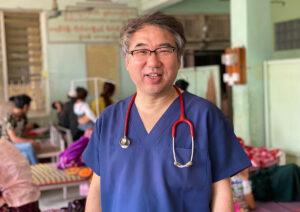 Dr. Hidehito Yoshioka is a pediatric surgeon who began providing medical care in Myanmar in 1995 and founded Japan Heart in 2004. He continues to support medical activities across South-east Asia.